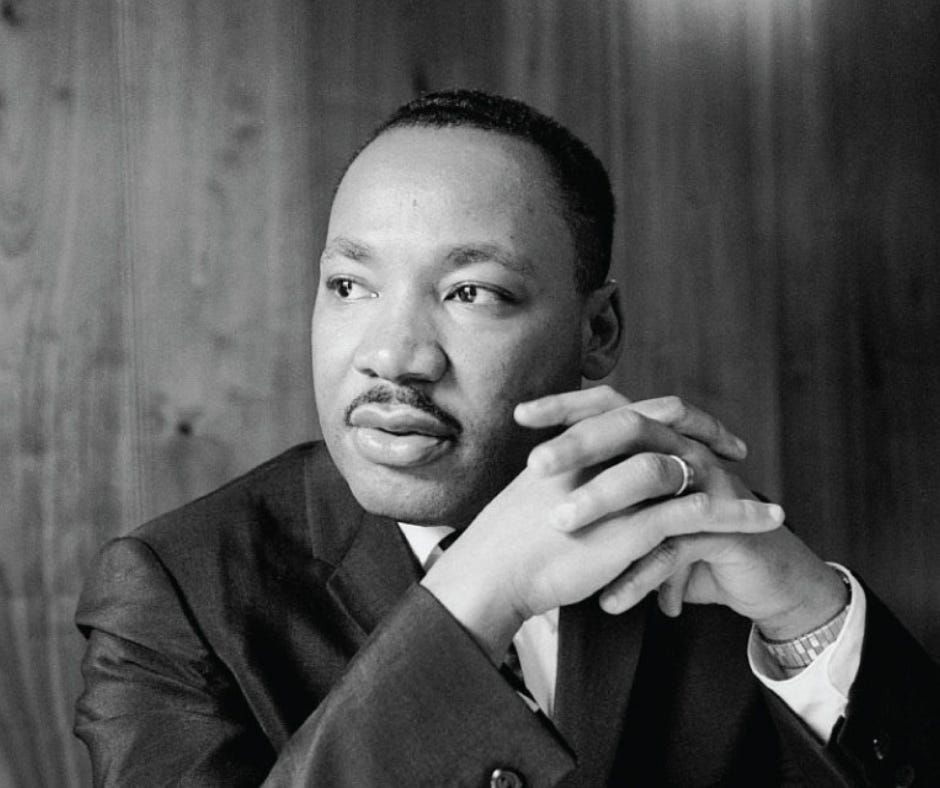
“The ultimate measure of a man is not where he stands in moments of comfort and convenience, but where he stands at times of challenge and controversy.” —MLK
Dr. Martin Luther King Jr. is remembered as a giant in history and rightfully so.
His words were etched into our moral imagination, and his courage helped shape the course of justice in America and around the world.
And yet, every year, especially on this day, the same question resurfaces:
What do we do with his humanity, and does it somehow discredit his legacy?
Before we dive into that, let’s keep it a buck about how we got here.
It would be naïve to treat this renewed fixation on King’s humanity as accidental or merely academic.
This is a concerted effort, particularly by those in power, to demonize King to diminish his legacy.
When a prophetic voice proves inconvenient, the strategy is rarely to engage the message on its own terms. Instead, the messenger is reframed, their complexity weaponized, and their humanity turned into scandal.
But, don’t be fooled, the aim is not historical clarity but moral erosion.
The idea is that if the man can be reduced to his vices, we can ignore his vision.
Unfortunately, this is not new. Power has always sought to domesticate prophets first by silencing them, and later by reshaping how they are remembered.
However, King remains a threat even in death because his message lives on.
His insistence on nonviolent resistance, economic justice, and the inherent dignity of every human being continues to interrogate our modern systems, still built on inequality and fear.
That is why the battle over his legacy matters.
A softened King, a compromised King, is far easier to celebrate with platitudes and holiday quotes than a King who still demands repentance, restructuring, and repair.
Back to my initial question:
What do we do with his humanity, and does it somehow discredit his legacy?
I don’t think so.
But, hear me out.
There is a deep temptation, especially in a cynical age, to believe that moral authority requires moral perfection.
However, Scripture tells a different story.
“We have this treasure in jars of clay to show that this all-surpassing power is from God and not from us.” — 2 Corinthians 4:7 (NIV)
The Christian story has never been built on spotless heroes.
Abraham lied.
Moses murdered.
David abused power.
Peter denied.
Paul persecuted.
And still, God advanced redemption through their lives.
Not because their flaws were insignificant but because God’s purposes were more important.
That remains true of King.
What those in power fail to realize is that their plan to highlight King’s humanity doesn’t dishonor him. It places him where he always stood: not above history, but within it. Not as a messiah, but as a messenger. Not as perfection incarnate, but as a man who bore the weight of his moment with courage, conviction, and cost.
The civil rights movement did not require a flawless leader; it required a faithful one.
To honor King is not to canonize him.
By canonize, I mean we do not need to pretend he was more than human.
The power has never been in the vessel.
The power has always been in the treasure it carries.
Before I go, in the spirit of calling a thing a thing: to focus exclusively on King’s humanity without honor isn’t discernment; it’s deflection.
But perhaps that is the hope behind the criticism:
To keep us so busy debating the man that we never have to deal with the message.